The Fetch Blog

Curated reads and events for professionals

Event Review: The Great Debate — September 16, 2012

Event Review: The Great Debate

What: The Great Debate, as part of Brisbane Writers Festival
Where: QPAC Concert Hall
When: 8 September 2012
Event review by: Amilia Cunningham, Brisbane Ambassador

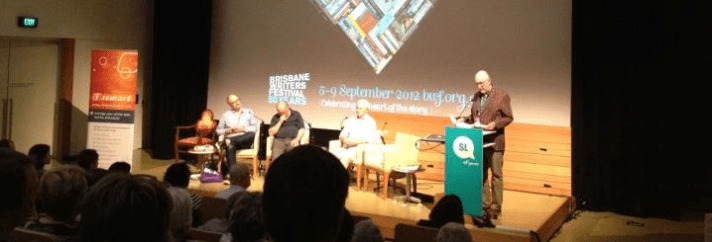
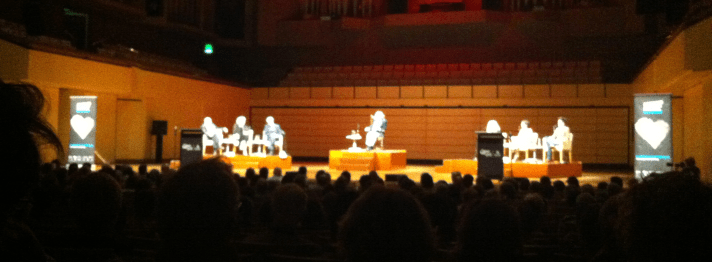
What happens when you put Germaine Greer and Bob Katter, two very controversial and polarising personalities, in a debate together?  Well… not much it seems.  The topic was ‘Reading the Bible is good for you’. Katter, Greer, and former Bishop of Edinburgh, Richard Holloway, represented the affirmative team. Californian P.I Rachel Sommerville, Magistrate Jacqui Payne, and author Benjamin Law, represented the negative team.

For the affirmative, Katter opened up the debate with references to Vikings and the movie 2001: A Space Odyssey.  Unfortunately I struggled to find the link to the topic, and it seemed like Germaine, up on stage, did too. I expected brashness from Greer, and despite her argument of the Bible being a ‘grand delusion’ (and the reason we should read it is so we can know how silly it is). She surprised me by being eloquent in her argument (perhaps she had used up her quota of controversial statements for the Festival during the opening of it).

Holloway, having the most religious background of the three, argued that the Bible is not a book, it’s a library, and that ‘we should read parts of it that are applicable…. to reclaim it from the bigots and the homophobes’.

Sommerville opened the floor for the negative team, discussing what she called ‘Lock Up Town’ – the second biggest city in the US being those who are under some kind of correctional supervision. Surprisingly, a high percentage of those living in areas that Sommerville calls the epicentre of Christianity (Louisiana), is doing time.

Payne gave the audience a few laughs by suggesting the top two reasons reading the Bible was bad for you was that the print was too small, and it was too long, so it can’t hold your interest.  But her real argument was how the Bible had contributed to the loss of aboriginal history.

Law compared the Bible to Game of Thrones – both have ‘nudity, sex, murder, revenge, bloodshed, torture, natural disaster, and homosexuality’.  He confessed that he actually had read the Bible as a child, but with a young impressionable mind, left to his devices to interpret (or misinterpret) the Bible’s stories led him to argue that indeed, it was not good for you.

There was time for rebuttal, but most of this centred on Holloway’s disappointment that Law would poke such fun at the Bible, feeling that he trashed something that was very sacred to many people.

Ultimately, the negative team won by audience cheer. However, debating lost. While there were some good arguments for both the affirmative and negative on the topic, it was apparent that the teams hadn’t actually had the chance to sit down and plan out their arguments, leading to lack of flow between the discussions.

What did you miss? Some laughs, a few pot-shots at the Bible, everyone’s confusion at Katter, and a rather contained Greer.

Amilia and Beck attended The Great Debate courtesy of Brisbane Writer’s Festival.
Event Review: Social Media Changing Lives —

Event Review: Social Media Changing Lives

What: Social Media: Changing Lives, at Brisbane Writers Festival
Organised by: TAFE Qld English Language and Literacy Services (TELLS
Where: State Library of Queensland
When: 8 September 2012
Review by: Amilia Cunningham, Brisbane Ambassador

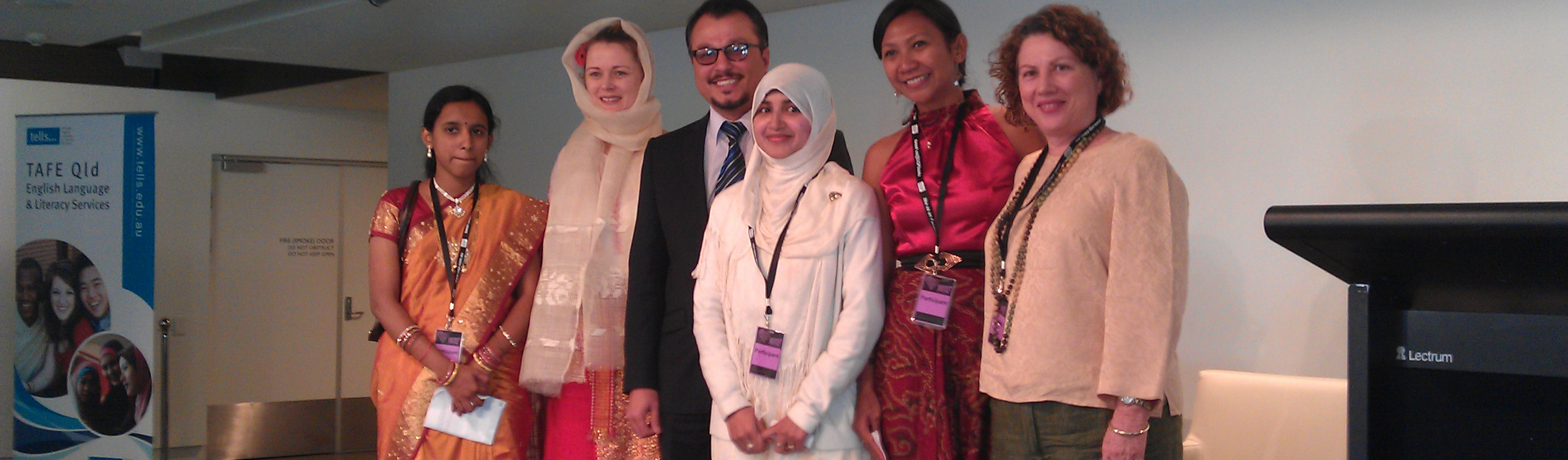
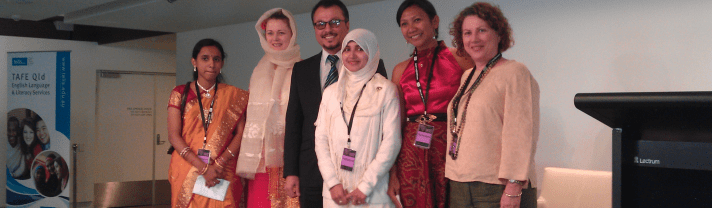
There’s been a lot of negative press recently about social media. So, when I read the description for the event ‘Social Media: Changing Lives’ at the Brisbane Writer’s Festival, I was expecting nice stories.  What I didn’t expect was the laughs, or the tears, the highs and lows, that the audience experienced in one simple hour. These stories of connecting with family overseas, conversing with husbands an ocean away, supporting each other in crisis and connecting a culture of people around the world were told by four young women, recent immigrants to Brisbane.  Two of their stories are below.

How does one sustain a relationship and marriage when you live in a different country to your husband?  Skype was a lifeline for Mukarrama from Bangladesh, who met her husband through a client, and after getting married, he moved to Australia for work, but she wasn’t able to follow him for almost 12 months. ‘We shared our stories, emotions, joys and sorrows.  It allowed me to have the emotional touch I needed’, she told the audience.

Another speaker, Margaretha, worked in mining in Indonesia.  Her story was raw, deeply sad and it was difficult for her to contain her grief.  There was only one helicopter that the mining company owned. In August 2011, it went missing and it became apparent in the days after, that it had crashed.  All 10 on board had died.  Through social media, their community was able to pull together and support each other and the families of the men who died.  She still keeps in touch with some of the wives now that she is in Australia.

As I consider moving overseas to work sometime in the near future, something that Mukarrama said touched me personally.  Now that she’s moved to Australia, she uses Skype to talk with her mother in Bangladesh.  She said ‘I never felt, before I moved to Australia, that I bore such a love in my heart for my mother’. And I know this will be me, in months or years to come, relying on social media to stay connected to those closest to me. And how thankful I am, that Skype and Facebook will enable that connection.

What did you miss? Heartfelt stories of connection, love, and supporting others through grief, and the positive power of social media.

Event Review: Beyond Greed —

Event Review: Beyond Greed

What: Beyond Greed, at Brisbane Writers Festival
Where: State Library of Queensland
When:  8 September 2012
Reviewed by: Lee Mathers, Brisbane Ambassador

It seems that, on the surface, everyone agrees that the “greed is good” days of Gordon Gekko are dead and buried. But “greed” remains a fascinating topic and is often the starting point for an investigation into the human condition.

After all, what is “greed”? Is it really just a desire for more? And more of what? Are we greedy in different ways, with different things? Is being greedy with your time really such a bad thing?

These were just some of the topics canvassed and discussed by an expert panel at the Brisbane Writers Festival. John De Graaf (Affullenza and What’s the Economy For, Anyway?), Peter Barry (I Hate Martin Amis et al.) and John Lanchester (Capital) covered everything from the rise of Indian and Chinese middle classes, over consumption, over work and the global economy through to the psychological effects of purchasing and money and why we’re all so miserable when we’ve never had it better.

Both Barry and Lanchester are fiction authors and read excerpts from their novels, detailing the effects of greed on each of their protagonists. De Graaf quoted at length from his most recent investigation into the American economy and came to the conclusion that we’re looking at it the wrong way.

He suggested that using our most common measure, Gross Domestic Product (GDP) as the measure for the growth and strength of an economy was doing more harm than good. For example, an oil tanker crashing and spilling its oil generated more economic value and therefore an increase in GDP – through the associated cleanup costs, litigation and all other manner of expenses – than a tanker arriving safely. But no one would ever suggest that that was a good outcome!

Instead, we need to reassess what the economy is actually attempting to do and attempt to refine those measurements.

De Graaf also quoted from one of his heroes, David Brower, the founder of Friends of the Earth and it neatly sums up the entire discussion on greed and the impact it has:

Consider the six days of Genesis as a figure of speech for what has in fact been 4 billion years. On this scale, one day equals something like six hundred and sixty-six million years, and thus, all day Monday and until Tuesday noon, creation was busy getting the world going. Life began Tuesday noon, and the beautiful organic wholeness of it developed over the next four days. At 4 pm Saturday, the big reptiles came on. Five hours later, when the redwoods appeared, there were no more big reptiles. At three minutes before midnight on the last day, man appeared. At one-fourth of a second before midnight, Christ arrived. At one-fortieth of a second before midnight, the Industrial Revolution began. We are surrounded with people who think that what we have been doing for that one-fortieth of a second can go on indefinitely. They are considered normal, but they are stark raving mad.

The conclusion of the panel? We may not actually be “beyond greed”. Everyone agrees that it’s not good, but we have a long way to go before we can hope to effect change.

Event Review: OzApps Roadshow —

Event Review: OzApps Roadshow

What: OzApps Awards Roadshow with Bill Tai
Where: River City Labs
When: 3 September, 2012
Reviewed by: Lee Mathers, Brisbane Ambassador

River City Labs hosted another of their numerous events catering to all things tech, when Bill Tai, legendary Silicon Valley venture capitalist visited to talk about the OzApp Awards and show off some of the very cool mobile apps that he’s invested in over the past few years.

The roadshow, ostensibly designed to encourage local app developers to submit their apps for the now expaned OzApp Awards (it started last year as a Western Australia only event), focused more on what it takes to build a successful app.

Bill spoke at length about the various apps that he’s invested in over the years and help to bring to market which include some relatively big players such as:

  • Tweetdeck: an app that makes it easier to keep track of your friends and other people of interest across all platforms of Facebook, Twitter, MySpace and any other social network
  • Maxthon: a fully-featured mobile browser used by millions
  • Tango: a VoIP and telephony client (similar to Viber and Skype) with over 60 million downloads
  • Voxer Walkie Talkie: a “push to talk” app for your mobile phone, turning it into a walkie talkie to use with your friends.
  • Scribd: A digital documents library that allows users to publish, discover and discuss original writings and documents in various languages

As well as backing new app ventures, Tai is a mad keen kite boarder and has helped to develop a kite boarding festival in Hawaii to mix investment in new digital products and applications with his love of the sport.

The session was full of good advice for all of those in the room working to get apps to market. Tai spoke at length about the three things you need to get right: finding the market, putting the team together and funding.

He encouraged developers from Brisbane to pitch their apps to the upcoming OzApps Awards in order to gain exposure and potential funding.

Event Review: ArtWrite —

Event Review: ArtWrite

What: ArtWrite – The Pitch
Where: QUT Art Museum
When: 21 August 2012
Reviewed by: Steph Dooris, Brisbane Ambassador

QUT Art Museum’s third seminar in the ArtWrite series focused on pitching to editors and featured Louise Martin-Chew (Brisbane arts writer) and Sarah Follent (editor of Eyeline Magazine).

Martin-Chew and Follent were the perfect choice for this seminar, as both have extensive experience working on either side of the table. Martin-Chew is a freelance writer who has written for The Australian, Australian Art Review, Art Monthly, InDesign and Green magazine, and previously worked as editorial manager at Art&Australia. Follent used to write for The Australian before her gig as Editor for Eyeline.

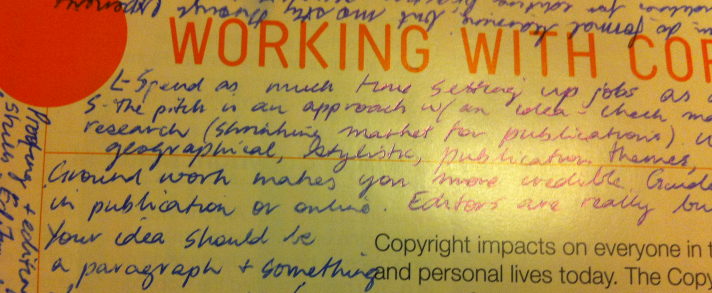
The hottest tip from the night was to research. Martin-Chew and Follent both strongly suggested knowing as much as possible about publications before pitching to them. They told the crowd that the best research was to just read the magazines and figure out what they cover, their deadlines and whether there are themes you will need to work within.

The next step, after reading up on who you want to pitch to, was to approach editors. For this, they suggested sending editors a short introduction of who you are and your previous experience (either with writing or in the arts industry), followed by a brief outline of your pitch. All in all, they suggested, the document should not be longer than a page. If you want to include a CV, Follent warned against making it longer as editors are unlikely to have time to look at much more.

When it comes to the actual writing, both Martin-Chew and Follent stressed the importance of sticking to word limits, checking grammar and proofreading. Although it may seem like common sense, the main message I took from this seminar was to be thorough in all aspects of the process, and to really know the magazine you are wanting to approach. The anecdotal advice of Martin-Chew and Follent, two heavyweights in Australia’s arts writing scene, was helpful, logical and reassuring, and definitely made this event a worthwhile way of spending a Tuesday evening.

QUT’s final ArtWrite seminar for the year, Copyright: Copyright for writers and artists, is on Tuesday 23 October at 6pm. RSVP via email (artmuseum@qut.edu.au) or call 07 3138 5370.

Design a site like this with WordPress.com
Get started