
The Fetch Blog

Curated reads and events for professionals

The top 10 business books every professional and entrepreneur should read — July 31, 2015

The top 10 business books every professional and entrepreneur should read

There are hundreds of thousands of books about business available today, which can make it tough to cut through the noise to find those that actually provide actionable advice. From great reads for startup CEOs to books about the importance of team building and psychology, we’re sharing a few of our favorites:

  1. The Lean Startup: How Today’s Entrepreneurs Use Continuous Innovation to Create Radically Successful Businesses by Eric Ries

    It’s an unfortunate fact that 80 percent of startups fail, but Ries believes that many of them don’t have to. When writing, he considers that a majority of failed companies don’t have the surplus time, money or manpower to complete extensive A/B testing and other market research strategies — so he offers advice about how to reduce product development cycles, find out what customers really want, and adapt to the marketplace before resources run out.

  2. Work Rules! Insights from Inside Google That Will Transform How You Live and Lead by Laszlo Bock

    There’s a reason why this book landed on both the New York Times and Wall Street Journal Best Seller lists. A company is only as good as the talent it attracts and keeps, so Bock offers an in-depth explanation for a proper manager-employee relationship. Furthermore, he lists the exact qualities to look for when adding members to a team and explains the importance of finding balance between encouraging creativity and maintaining structure. Google is consistently rated one of the best places to work, and the insights shared here make it easy to understand why.

  3. The Facebook Effect: The Inside Story of the Company That Is Connecting the World by David Kirkpatrick

    How did a student create one of the fastest growing companies of all time, completely transforming the Internet and how humans interact online? Here, veteran technology reporter Kirkpatrick offers a detailed history of Facebook and how it became the incredible company that it is today. This impressive, inside story speaks to why Facebook was started, the company’s early missteps, power of uncompromised vision, struggle between growth versus profit, and what’s next.

  4. Hooked: How to Build Habit-Forming Products by Nir Eyal

    It’s a well-known fact that it’s easier and more cost-effective to keep a customer than acquire a new one. Eyal takes this concept a step further by exploring intriguing questions such as: why do some products get mass attention while others just flop? What makes a product so addictive that the customer can’t put it down? Is there a pattern as to how technologies hook us? Based on years of research, experience and consultations, Eyal is able to share smart findings along with practical, actionable steps for building a successful product.

  5. Hot Seat: The Startup CEO Guidebook by Dan Shapiro

    One of the best ways to learn is by example, and Shapiro’s book is chock-full of summaries that cover companies with varying degrees of success. Vividly explained are the five stages of a startup CEO, how to finish with respect to board members, staying loyal to a management team, and tips for maintaining financial security. As one reviewer wrote, “The thing that sets Dan’s writing apart from other startup books/blogs is his focus on translating his experiences (across several different types companies) into actionable advice for other entrepreneurs.”

  6. Mindset: The New Psychology of Success by Carol Dweck

    “In a growth mindset, people believe that their most basic abilities can be developed through dedication and hard work—brains and talent are just the starting point. This view creates a love of learning and a resilience that is essential for great accomplishment. Virtually all great people have had these qualities.” We’ve all heard the popular phrase “mind over matter,” and Dweck builds on this age old theory that with the right mindset, you can change your internal dialogue from being judgmental to helping one to grow; from praising talent to acknowledging hard work. Many have deemed this a must-read for anyone in a leadership position (including managers, teachers, parents and even CEOs).

  7. Hackers And Painters: Big Ideas from the Computer Age by Paul Graham

    Graham takes the unique approach of drawing on historical events and examples to explore what he calls, “an intellectual Wild West” in this series of essays. As computers swiftly take over our lives, Graham discusses the roles of programmers, hackers, and software designers and how they will forever change how we think and live. While you may disagree on some of his views on life, it will certainly get you thinking.

  8. The Art of the Start: The Time-Tested, Battle-Hardened Guide for Anyone Starting Anything by Guy Kawasaki

    In the 1980s, Kawasaki helped shape Apple into one of the greatest companies of the century. As founder and CEO of Garage Technology Ventures, he has field-tested his ideas with dozens of entrepreneurial companies. With the incredible experience and success to back up his theories (presented with humor and real-world savvy), Kawasaki brings an arsenal of ideas to equip any business owner for potential challenges.

  9. Zero to One: Notes on Startups, or How to Build the Future by Peter Thiel

    Theil started PayPal in 1998, led it as CEO, and took it public in 2002 — establishing a new era of fast and secure online commerce. Here, Theil shares his personal insights and anecdotes while raising important questions for budding entrepreneurs, including: Is now the right time to start your particular business? Will your market position be defensible 10 and 20 years into the future? Do you have a way to not just create but deliver your product? Are you starting with a big share of a small market? With strong ideas and principles to help build the foundation of any business, Thiel’s advice shouldn’t be missed.

  10. The Pumpkin Plan: A Simple Strategy to Grow a Remarkable Business in Any Field by Mike Michalowicz

    If you want a simple, cut-to-the-chase approach to launching a startup, this is it. Michalowicz explains his path to success in just three simple steps: 1) Plant the right seeds by identifying the thing you do better than anyone else and focus all of your attention, money, and time on figuring out how to grow your company doing it; 2) Weed out the loser customers that waste your time and invest in the customers that add the most value and provide the best opportunities for sustained growth; and 3) Nurture the winners by focusing on how you can make their wishes come true and deliver on every single promise.

About our contributor // Christina Morales is a freelance writer specializing in creating online marketing content. Her dream is to one day rule the world with just an iPad, a case of Cherry Coke, Twizzlers, and a glue gun.


Coffee talk: Krista Gray, director of community operations at The Fetch — July 13, 2015

Coffee talk: Krista Gray, director of community operations at The Fetch

Meet Krista Gray, the new Director of Community Operations at The Fetch! A passionate traveler, Krista also loves tech and bringing people together. Here, she shares her story and why she’s so excited to be working with The Fetch community.

How did you end up where you are today?

Still in my first few weeks of experimenting with life as a ‘digital nomad’, I’m currently working from one of my oldest friend’s newly purchased home in Connecticut. This is amazing because I left New England about seven years ago to pursue a change of pace in California. My time on the West Coast has consisted of a two year stint in Carmel-by-the-Sea before moving to San Francisco to help build a startup (which turned into several startups over a five-year span). Just recently, I left my last role to spend this summer with people I’ve missed dearly for nearly a decade. The best part? While I’m temporarily back where I started, I’m able to work with The Fetch!

Why did you want to get involved with The Fetch?

I’ve followed The Fetch since meeting Kate Kendall at a Skillshare class she was teaching about Community Management in 2012. At that time, I had just moved to the city and jumped into the entire startup ‘scene’. The concept of The Fetch resonated so deeply with me as it was exactly the kind of resource I found myself searching for. Starting over in a new place/industry is overwhelming, and having a cheat sheet for the the right kind of events along with access to carefully curated, intelligent reads can make it much easier to get acclimated and involved.

What things excite you about our community right now?

The sheer volume of incredible things that Fetchers are working on! I’m so impressed with the passion and knowledge each person brings to the community, and eager to help them all make the most of their work-life.

What events do you recommend in San Francisco?

I love Inforum (a division of the Commonwealth Club) for their conversation series. I recently had the pleasure of watching Molly Ringwald interview Judy Blume at the Castro Theater, and it was really enlightening to hear each woman discuss her respective creative endeavors, sources of inspiration, and challenges encountered over the last twenty years. These events are also a great place to network with like-minded people and make new friends.

What’s your favourite thing about your city?  

The weather. No, seriously! A lot of folks complain about the fog, particularly in the summer, but I think there’s a certain bit of magic to it. I love San Francisco’s temperate climate and the opportunity to layer clothes everyday, nearly year round. ‘Sweater weather’ has always been my favorite. 🙂

What’s unique about San Francisco?

I think the people are what make San Francisco truly special and unique. The tech industry attracts such a diverse range of people from varied cultures, backgrounds, and experiences. I’ve found that people I’ve met in San Francisco also seem to share a sense of heightened awareness in terms of gratitude — it’s refreshing to be surrounded by such great minds that are also deeply appreciative.

Where can we find you in San Francisco?

If I’m not at The Roastery, you’re likely to find me at a Bar Method class or getting fresh air in one of my favorite places: the Lands End Trail, Palace of Fine Arts Theatre, or Crissy Field. I’m also a huge fan of sunsets, and like to watch them from friends’ roof decks or the city’s best vantage points.

How can we connect with you?

Keep up with my adventures by reading my journal, or give me a shout on one of my favorite social sites — Twitter or Instagram.

If you didn’t live in San Francisco, where would you be?

San Francisco is easy to fall in love with, and really difficult to think about leaving for a long amount of time. However, if I didn’t call the City by the Bay home, I think I’d try life in a European city. I’ve spent a fair amount of time in Rome and marvel over how different the daily grind is. I think we learn the most when we push ourselves out of our ‘normal’ routines and overlaps, and trying something so different could be a really fun and productive way to keep growing personally and professionally. Time will tell!

Last, how do you like your coffee?

It depends. I’m somewhat of a rare breed in that I don’t have a go-to coffee selection. I’ll often drink it black, but there are days that I mix in cream and raw sugar. Additionally, I can never resist a coconut iced coffee at Breaking New Grounds in Portsmouth, NH when I’m visiting home. They flavor the beans, and it’s simply the best.

Featured job: full-stack software engineer, Thread, London — March 11, 2014

Featured job: full-stack software engineer, Thread, London

thread

Hi! We’d like to introduce Thread – a company reinventing retail so guys can dress well without being subjected to the horrors of high street shopping, or having to trawl through millions of items online.

They do this by using a clever combination of algorithms and human stylists to give guys the perfect selection of things that will look amazing on them. Their goal is to create the new global default for how men buy clothes.

They’re live, have lots of customers who absolutely love the product, and revenues are growing very quickly. [Job application details are down below!]

Building one of the best engineering teams worldwide

One of their ancillary goals is to build one of the best engineering teams and cultures anywhere in the world. This means putting a lot of time into ensuring they only hire truly exceptional developers and creating the best working environment possible.

They’re lucky to already have a number of exceptional developers on the team which you’ll get to work alongside, learn from and no doubt teach. For example, their co-founder/CTO was formerly a lead engineer at Google, their technical architect is a core Debian developer, etc. If you want to work somewhere where you will be learning from some of the best engineers around, this role would be a good fit.

You’ll work everyday with an awesome technology stack consisting of Python, Django, Git, Debian, Redis, jQuery, Jenkins, Postgresql, Gunicorn and many other things.

They place a high value on learning and personal growth so you’ll have time to learn new technologies and attend conferences at the company’s expense. They also host a bi-monthly meetup at their offices for engineers interested in startups called Many to Many.

Beyond this, you will get the chance to demonstrate your deep technical ability by tackling some hard technical challenges including recommendation algorithms and machine learning. They release 20-30 times per week (just push to master) so your cool new features will be live on the site within moments.

Not your average software engineering role

As employee number 12 and engineer number 4, you’ll work directly with the founders and the rest of the outstanding technical, design, product and styling team in the office in Shoreditch, London to build the core features that will improve people’s wardrobes and in turn their self-confidence and happiness.

You won’t merely be handed specs: you’ll be in charge of taking ideas from the whiteboard all the way through to them being live, tracking the results, and iterating to make them better. For this reason, this role is only suitable for someone who likes being closely involved in product – what to build and how it will work as much as the technical implementation itself.

Beyond your engineering team mates, you’ll be working closely with a cross-discipline group of designers, quantitative marketers, operations and stylists. You should love the idea of the whole company working closely together to hit shared goals.

This role is especially suited to someone who wants to found their own startup one day. All our current team are future founders and they view working there as an entrepreneurial bootcamp that will give you the necessary skills and experience to launch your own company in the future.

Are you the one? You are, if you:

  • Love agile development, working independently on your own challenges, and together in a team on the bigger vision
  • Are completely fluent in at least one scripting language such as Python, Perl, PHP or Ruby and have experience with web frameworks and the MVC concept
  • Have used MySQL or PostgreSQL extensively and you know your way around Apache, nginx or other server
  • It’s a bonus if you have good JavaScript skills (we use jQuery)
  • Get excited by the idea of scaling web apps to millions of users
  • Often find yourself as the best developer in your peer group, and want to be at a place with other exceptional engineers where you can learn and grow as a person
  • Get obsessed about the problem you’re solving and don’t stop until you’ve cracked it
  • Have a thirst to learn new skills and technologies, and can pick things up easily
  • Want to have fun building lots of new features and get stuff done
  • Are full of positive energy, relish the thought of being part of a small, fast-moving team and enjoy brainstorming about new ideas

Benefits

  • Opportunity to become recognised as one of the best in your field through being a core developer for a high-profile startup
  • Relaxed, sociable work environment with lots of freedom and independence
  • Building an exciting app that millions of people will use and appreciate everyday
  • Gain first-hand experience of how to start, grow, market and raise funding for startups (perhaps useful for your own company one day)
  • Working with awesome technologies (Python/Django/jQuery/Debian/Git/Redis/Jenkins/Postgresql/Gunicorn)
  • As part of one of the top technical teams in the UK, alongside super smart people who have a lot of fun, devoid of any politics
  • With dual-widescreen monitors, a new computer of your choice and and comfy ergonomic chair
  • Free team lunches once a week (we take turns choosing), beer together as a company on Fridays, monthly company trips to fun things like comedy shows, unlimited vacation time.
  • Being part of a company where you will get to help set and shape the company culture in a big way
  • A competitive salary and a generous equity stake in the company (you’re working hard to make the company successful, so we believe you should share generously in the reward!)

A little more about Thread:

  • Backed by some of the top investors anywhere in the world, including the founders of LoveFilm, Wonga and Bebo, the former owner of Warner Music, the former head of Harrods, founding investor in Spotify, Y Combinator, and many others.
  • Founded by serial entrepreneurs who have started two successful startups which both exited.
  • They’re very deliberate and intentional about creating a high performance, warm and effective company culture. They set weekly goals together as a team, and celebrate every Friday with a fun shared treat if they all hit them. Lots of thought has gone into the working environment they’ve created – please ask them about this if you meet!
  • Lastly, they’re not just some social app hoping to go viral and make money from ads – they’re already generating real revenue which are growing very quickly.

If this sounds exciting and you’d like to have an informal chat, send an email to ben@thread.com with a few sentences about yourself, your resume and links to your Github/LinkedIn/site/etc.

Image credit: Thread.com (follow them on Twitter and Facebook)

Hooking users in three steps: an intro to habit testing —

Hooking users in three steps: an intro to habit testing

gamification-in-business-illustration-web

The truly great consumer technology companies of the past 25 years have all had one thing in common: they created habits. Nir Eyal, the author of Hooked: A Guide to Building Habit Forming Products and NirAndFar, explains.

This is what separates world-changing businesses from the rest. Apple, Facebook, Amazon, Google, Microsoft, and Twitter are used daily by a high proportion of their users and their products are so compelling that many of us struggle to imagine life before they existed.

But creating habits is easier said than done. Though I’ve written extensively about behavior engineering and the importance of habits to the future of the web, few resources give entrepreneurs the tools they need to design and measure user habits. It’s not that these techniques don’t exist — in fact, they’re quite familiar to people in all the companies named above. However, to the new entrepreneur, they largely remain a mystery.

I’ve learned these methods from some of the best in the business and put together an amalgamation of them that I call “Habit Testing.” It can be used by consumer web companies to build products that users not only love, but are hooked to.

Habit testing

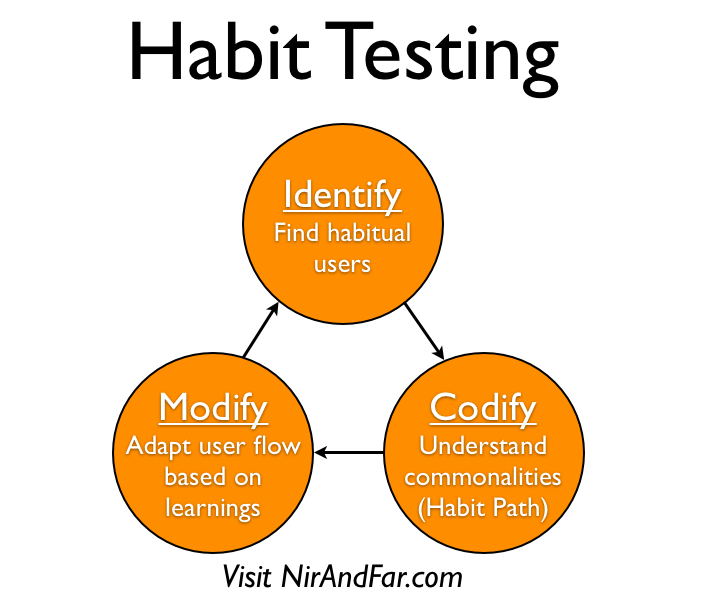
Habit Testing fits hand-in-glove with the build, measure, learn methodology espoused by the lean startup movement and offers a new way to make data actionable. Habit Testing helps clarify three things: 1) who your devotees are; 2) what part of your product is habit forming, if any; and 3) why those aspects of your product are habit forming.

A prerequisite to Habit Testing is having some kind of product up and running. Of course, before launching even a minimal viable product, it’s a good idea to take a stab at your business model hypotheses and how your product will create user desire.

Once you have a site or app live, you can begin collecting data. Habit Testing does not necessitate collecting data about everything — just the right things — so setting up the appropriate analytics is critical. In order for Habit Testing to be successful, you need to date stamp the path users take while using your site.

Step 1 – Identify

Now that you have the requisite site and stats, you need to answer the first question of Habit Testing: “Who are the habitual users?” First, define what it means to be a devoted user. Ask yourself how often a user “should” use the site. That is to say, assuming that some day all the bugs are worked out and the product is perfectly “lickable,” how often would you expect a habitual user to be on the site?

Be realistic and honest. If your company builds a mobile social networking app like Foursquare or Instagram, you’d expect habitual users to be on the app several times per day. However, if you’re building a movie recommendation site, a la Flixster, you wouldn’t expect users to be on the site more than once or twice a week. Don’t come up with an overly aggressive prediction that only accounts for uber-addicts; you’re just looking for a realistic guess to calibrate how often users will interact with your site.

A good short-cut might be to take an average of how often you and the people in your office use your own product. Of course, more is better. Twitter was born within Odeo, the company Biz Stone and Jack Dorsey originally founded, because the engineers couldn’t stop playing with it.

One thing to note: the more frequently your product is used, the more likely it is to form a user habit. That’s not to say that web products that are used rarely can’t be good business, they just aren’t habit forming and thus have different characteristics. Viable, though non-habit forming businesses tend to be more transactional and require constant outreach to customers to stay top-of-mind.

For example, think of the travel industry’s relentless war to convince us to use one site over another. Expedia, Travelocity, and the rest, are used too infrequently by their average customers to form a habit, so they constantly compete for attention. These are viable, even profitable companies, but since they are non-habit forming products they are open to greater competitive threat. Products used daily naturally create barriers to entry in their markets.

Who’s got the habit?

Now that you know how often a user “should” be using the site, it’s time to crunch through the numbers and identify how many of your users actually meet that bar. This is where hiring a stats wiz can prove exceedingly helpful. Instead of pulling your engineers away from their crucial jobs building the product or even worse, getting your business people to do it, consider hiring a grad student fluent in statistics to help you quantify how many of your users are hooked. The best practice here is to get create a cohort analysis to provide a baseline by which to measure future product iterations.

Step 2 – Codify

Hopefully, you’ll have at least a few users who interact frequently enough for you to call them devotees. But how many devotees is enough? My rule of thumb is 5%. Though your rate of active users will need to be much higher to sustain your business, 5% is a good benchmark to being Habit Testing.

However, if at least 5% of your users don’t find your product valuable enough to use as much as you predicted they should, you have a problem. It may be time to go back to the drawing board and rework your vision. But assuming you’ve exceeded that bar and you’ve identified your habitual users, the next step is to codify the steps they took using your product so you can understand what hooked them.

Each user interacts with your product in a slightly different way. Even if you have a standard user flow, how users engage with your site creates a unique data fingerprint which can be analyzed to find patterns. Sift through the data to determine if there are similar behaviors that emerge. What you’ll hopefully discover is a “Habit Path”, a series of similar behaviors shared by your most loyal users.

For example, in its early days, Twitter discovered that once new users followed enough other members, they hit a tipping point which dramatically increased the odds they would keep using the site. Every company has a different set of actions that devoted users take; the goal of finding the Habit Path is to determine which of those steps were critical for creating devoted users.

Get in their heads

Now that you know the Habit Path, the next step is to create hypotheses about what it was along that path that tipped users from passers-bye to devotees. Granted, this step can look a little like assuming causation from correlation; but in the murky fog of launching a new product, it’s often the best thing we’ve got.

This phase is also a good time to talk to users in person to learn more about why and how they use the product. Habit Testing is meant to illuminate what is unique about these “earlyvangelists” and find insights that can be generalized to the rest of your users.

Step 3 – Modify

With new hypotheses in mind, it’s time to get back inside the build, measure, learn loop and take new users down the same Habit Path the devotees took. For example, leveraging their Habit Path, Twitter’s onboarding process now guides new users to start following others immediately.

Habit Testing is a continual process companies can implement with every new feature and product iteration. Tracking users by cohort and comparing their activity to habitual users should guide how products evolve, improve, and foster habit formation.

Too often tech entrepreneurs find themselves alone with their vision because they fail to realize the importance of creating user habits. And unfortunately, when it comes to consumer web and the ever-increasing distractions we all face daily, if the product doesn’t create a habit, it may as well not exist. By using Habit Testing to determine what is most valuable and habit-forming about a product, entrepreneurs can better serve their users and increase the odds of creating world-changing companies.

About our contributor // Nir Eyal is the author of Hooked: A Guide to Building Habit Forming Products and blogs at NirAndFar.com.

The Habit Summit brings together experts and luminaries to share their insights on habit-forming product and services. Happening in the Bay Area on March 25 2014 at Stanford, use this link for $50 off: https://habitsummit.eventbrite.com/?discount=Fetch

Image credit: AKTA

Work-life haven: why entrepreneurs and digital nomads are settling in Bali — January 23, 2014

Work-life haven: why entrepreneurs and digital nomads are settling in Bali

02-Hubud-corporate-01

“I’ve never been as productive as I have been living in Bali. There’s an opportunity here to access yoga, healthy food and fresh air that’s more difficult to come by in a city. It’s a place people come to get perspective on their lives… a unique opportunity to get perspective and focus.”

Bali, with its tropical climate, laid-back lifestyle, beaches, jungles and cheap beer, has long been a holiday-maker’s paradise. The ‘Island of the Gods’, a province of Indonesia, is a popular playground and place of reflection for Australian, Asian and, since Julia Roberts had a mid-life crisis on its shores in Eat Pray Love, American travelers. In recent years, the very reasons for the island’s booming tourist trade have also made it an attractive place to do business from. Bright, driven folk striking out on their own have realized they can live and work in paradise, rather than just holiday in it. So what business realizations are travelers having on their wanderings around the island?

  1. Eat, drink and generally live like a king = cost of living (and of doing business) is low relative to developed economies, and time can be bought back by outsourcing the chores of life.

  2. Relax and reflect in paradise = escape the daily grind of big cities and stresses of everyday life, and gain new perspective on your work.

  3. Soak up the island’s renowned nutrition, wellbeing, art and culture pursuits = immerse your work mind in a creative, inspiring and energetic atmosphere.

Peter Wall, co-founder of the island’s first major co-working space, Hubud, speaks of the hinterland town of Ubud as the island’s creative hub, and the perfect place to escape the rat race:

“Bali has always been recognized as an incredible creative hub. You can come here and experiment, do things a bit differently, step back from the business and work harder or smarter. The day-to-day grind in a big city can wear you down. Living here no-one doesn’t want to come to work. No-one is doing things they don’t want to do. There’s a really nice energy in our space; there’s something about getting out of your normal cubicle and working in a space that feels different.

“My commute to work is two-and-a-half minutes through a monkey forest. I’ve never been as productive as I have been living in Bali. There’s an opportunity here to access yoga, healthy food and fresh air that’s more difficult to come by in a city. It’s a place people come to get perspective on their lives… a unique opportunity to get perspective and focus.”

33-DSC_4407

With over 200 members, and around 50-60 daily coworkers, Hubud is one factor in the growth of Bali’s creative and startup business community. Wall and co-founder Steve Munroe use the space to help build a stronger community of entrepreneurs, hosting 25 events in November, encouraging ‘exchangeable learning’ and sponsoring hackathons and Indonesia’s social innovation award. The pair are also developing a ‘soft landing solution’ for new arrivals which will include airport pickup, phone number and phone, accommodation, cleaning, laundry, food, desk space and other support for a monthly rate. Understanding and transparency of costs is a sticking point for many, according to Munroe.

A similar set-up can be found at co-working and co-living startup accelerator, Startup Getaway, located near Denpasar and offering offers one, three or six-month stays for entrepreneurs to work on their startup without any distractions or daily chores. The same team is also behind the 30-day networking event Project Getaway and the Contenga International co-living and coworking environment.

One of the facility’s alumni, co-founder and CEO of Windows mail client Mailbird, Andrea Loubier, says the community in Bali is fresh, innovative and creative but, like a startup, still in its early stages. Originally from Cincinnati, Ohio, Loubier has stationed her team – a mix of Danish, Indonesian and Colombian nationals – in a town between Ubud and Kuta. She believes:

“Operational costs can be bootstrapped much easier than in the US or Denmark, simply due to the high cost of living in Europe and America.

“It’s beautiful here; it’s in an up-and-coming, rapid-growth market, with Indonesia being the fourth largest population in the world. The tech industry is growing rapidly as well, and more and more students are seeking degrees in technology which is very promising for building a stronger economy in Indonesia. We have some of the best team members on Mailbird from the prestigious Institute of Technology Bandung right here in Indonesia. We are excited to be part of the movement specifically in Bali, where we already feel that our startup community is a great example of eliminating the extra day-to-day to-do’s, so you can fully dedicate your time to building an exciting business while also enjoying life.

“It’s funny when you tell people that your startup is based in Bali – they’re surprised or don’t take you seriously. Then they are surprised when they see the traction and global awareness of the startup.”

“Our little, Bali-based startup has been recognized worldwide after we were picked up by major tech news publishers and blogs like TechCrunch and Lifehacker.

“The warm weather keeps you happy and very motivated in Bali too.”

Another coworking space in the island’s coastal town of Sanur, a female entrepreneurial group called Secret {W} Business and #subali meetups add to the community on the island.

Three years ago, TEDx made its way to Bali’s shores, started by digital designer Daniela Burr. Earlier this year the event was attended by a curated group of 400 innovators, creatives, cultural leaders and social pioneers. Burr started TEDxUbud after falling in love with the island:

“It happened unintentionally. I took a sabbatical in 2010, inspired by designer Stefan Sagmeister and came to Bali following his advice. I loved it. I started TEDxUbud just two months after landing and it grew exponentially, completely changing my life. I run a digital design studio and have the ability to work from anywhere… Bali quickly became the perfect spot. I’ve met the most incredible people on this island, we now have a great co-working space, and I get to live what I always thought was a dream life.”

Working in paradise, and in a developing country remote from  major business centers, has its drawbacks, but those working there find them insignificant compared to the benefits. Budgeting, safety, language/cultural barriers and internet speed can be factors to contend with, but are issues easily managed. Access to outside networks, events and resources not yet established in Bali also need to be managed – raising investment requires flying in or flying out, for example.

The picture painted by the entrepreneurs and digital nomads who’ve chosen the Bali work-life haven is a rosy one. The business case is strong, and the vibe of the island is proving for many to be the special ingredient needed to unlock inspiration and creativity. It’s not hard to see why it’s becoming a hub for startup business and creative industries.

Additional links:

Follow @thefetch  on Twitter and subscribe to our global weekly email digests at http://thefetch.com.

About our contributor // Chris Byrne is a writer working on the journalism-marketing merger. He’s a data journalist, content and comms freelancer. Follow him on @penseive.

Image credits: All photos from Hubud coworking community.

Design a site like this with WordPress.com
Get started