As part of the Vivid Ideas festival, community ambassador Mark Woodrow went along to the Participatory Revolution, an event inspired by Michelle Williams, connector, collaborator and founder of Ideaction.
Panel discusses big Vivid Ideas on participation
“There is the same power in our phones as what took humans to the moon.” Michelle Williams inspires passion in us all to join the revolution in opening the half day conference at the MCA in Sydney, 27 May.
“This is the era of creativity. Participation the new consumption.”
It’s not what we consume, it’s how we participate
Greenpeace CEO David Ritter defined their early vision with blunt clarity in quoting David McTaggart “We have to get our world into 21st C in one piece. Fuck everything else.” Greenpeace works by active participation. The latest campaign targets the horrendous damage by plastics on bird life. Two thirds of Australian sea birds are choking on a stomach full of plastic. You can participate by not purchasing from a multinational like Coca-Cola, which shows no interest in recycling. And watch the compelling ad that was censored by mainstream Australian media.
“Greenpeace’s mission hasn’t changed but now there are many more options for activism.The action items on the menu for social change have expanded in the rich opportunities contained in digital age.”
Participatory democracy and citizen centricity
‘Social media is just a part of a broader cultural change’ according to self proclaimed geek and open data advocate Pia Waugh. Gov 2.0 means 3 key things:
1. open data, 2. participatory democracy, 3. citizen centricity.
It is good to have Pia representing the thoughtful application of technology in government and promoting that as citizens we should all be central participants. “For two years, we’ve had more people engaging with government online than through any other medium”, says Pia.
Learning to be a citizen scholar
James Arvanitakis is the lecturer you wish you had at University, winning a Prime Minister’s award for being the most popular Australian lecturer in 2012. He advocates participatory education where we trade knowledge to attract students – we need more citizen scholars, as “Students aren’t empty vessels”.
Like newspapers, James believes the model for traditional university education is outdated. Studies show that attention in lectures goes downhill from 12 minutes. James overcomes this by interacting before, during & after lectures with downloads, and interacting on Facebook.
“Knowledge is like a big picnic. If we all bring something & contribute it will be awesome. We need to get students ready for jobs that don’t exist”
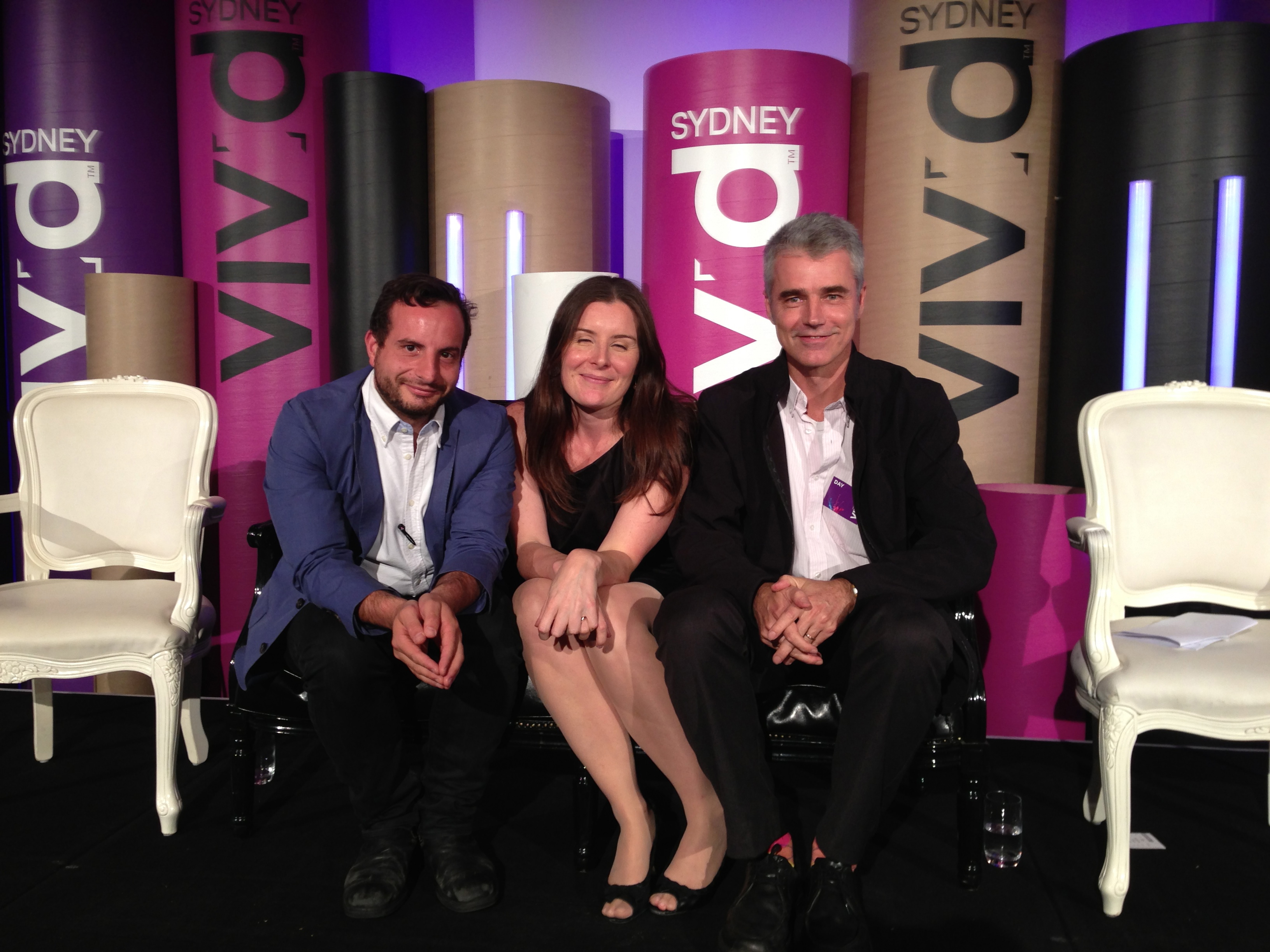
Dan Ilic (Very funny MC), Michelle Williams (Amazing Curator), Mark Woodrow (Fetching)
Know your sense of purpose
People are interested in doing the right thing and changing the conversation, according to Paul Bennett, Creative Director at renowned design firm IDEO. But to truly participate we need little less conversation, a little more action. Paul recommends we:
1. Have a higher purpose. ‘Know your sense of purpose’, but it needs to be integral, “Purpose is not a layer that you just add on top”.
2. Make stuff. ‘Less talking more doing’ is what leads to human centered design.
3. Be transparent about success & failure. Leap forward into growth rather than step back into safety.
4. Play well with others – collaborate. Assume the good. “If you care about solving problems, you can’t try and own the solution”
The rule at IDEO is that everybody is in it for everybody. Incredibly IDEO puts everything online. You can see it all, download it. frameworks , designs etc. According to Paul:
“Burning eyes are the business eyes of the future”
The Maker Movement
Yammers Steve Hopkins is all about eliminating silos. “How you make things is as important as what you make”. Makers are true participants and they are on a different schedule. For a further insight read Paul Graham’s Maker’s Schedule versus Manager’s Schedule
For projects to work, Steve’s suggest’s the Yammer formula:
“Two to ten people in a team for between 2 to 10 weeks. Never longer”
For Ian Lyons, the ‘maker movement’ is increasingly creating value. Ian makes drones (pilot-less flying machines) and suggests you investigate over funded projects on crowd funding platforms, such as KickStarter. These are a great source of market research. Collaboration is the key – find a community that will help you build what you want. There are great Australians ‘Maker Spaces’ including Robots & Dinosaurs, Ozberry Pi, Ninja Blocks and Dorkbot. These vibrant, creative communities that provides access to tools, software, space, ideas and support. As do #coworking spaces. You just need to search them out to participate.
The time is now. Reward collaboration over competition. Join the participatory revolution. Vive la révolution!
—
About our Ambassador // Mark Woodrow. Prefers the more informal self-appointed title of No1 Fetch Fan. Runs a design and communication consultancy, The Galaxy. Resides at Hub Sydney. On the NSW Board of International Assoc of Business Communicators. You can connect with Mark on Twitter @markwoodrow
This week, The Fetch London’s Community Ambassador, Alexandra Leslie, spoke with Rory O’Connor, CEO and Founder of Scurri.
So let’s get to know each other! Can you tell our readers a little bit about yourself?
In my early career I worked in Waterford Wedgwood, spending time in various sales, marketing and strategic project roles. This included being part of the team that delivered a €10m SAP implementation, where I got my initial taste for big technology projects. I subsequently worked as a consultant and was lucky to work with clients such as Heineken, Intel, Euronics and Siemens and spent a period as a project manager with AOL Broadband. I travel a lot with work and I am based in London during the week but home is with my wife and four children in Wexford in the south east of Ireland.
How did you get involved with Scurri?
I was working as a consultant, when I got the initial idea and saw an opportunity to create a website which would connect up transport companies to create a virtual network of carriers that would make the delivery process easier for consumers. I was still running my own consultancy business, but I put in some of my own funding at the end of 2010 and hired a developer to design a prototype website. I had this vision of using technology to make delivery simpler and more efficient.
What is Scurri, and why should people use it over other delivery methods?
Scurri provides a cloud based solution for multi channel retailers and e-Commerce merchants who ship physical goods and need to integrate multiple carriers. The delivery management platform provides the merchants with the tools to tackle and reduce delivery related shopping cart abandonment and unlike our competition, the platform is cloud based making it an economical service that is fast and agile to deploy!
How is Scurri innovative in eCommerce?
Scurri provides a cloud based solution for multi channel retailers and e-Commerce merchants who ship physical goods and need to integrate multiple carriers. The delivery management platform provides the merchants with the tools to tackle and reduce delivery related shopping cart abandonment and unlike our competition, the platform is cloud based making it an economical service that is fast and agile to deploy!
Do you think other delivery systems will catch on to Scurri’s simple methods?
I think some will find it hard to change as they have taken a long term bet on older technologies and they will struggle to change from their legacy systems even if they really want to. I am sure other smaller and newer companies will copy what we do, thats really inevitable in this day and age. However we are working hard on maintaining and growing an amazing culture within the company. We really believe that its so important to be always listening to our customers needs and we need to continue to embed lean and agile methodologies into the way we work. Its our culture and way of doing things that will ensure that we will continue to be innovative and customer focused and culture is very hard to be copied.
What’s the worst story you’ve ever heard of someone losing something in the mail?
We have seen many different items getting lost including one time a lady opening her parcel to find the designer clothes she had purchased had been mixed up with a parcel of packing tape due to the wrong goods being packed into the wrong box . Our customer used our tools to work out where the clothes had gone and everything was sorted out relatively quickly once the mistake was identified. I do remember reading however that last year post that was lost in the Royal Mail system turned up after 23 years. Once it was found Royal Mail reunited the missing letters with their rightful owners and I bet it was a surprise to see that post coming through the door after so many years.
_____
Written by Alexandra Leslie, The Fetch London Community Ambassador. Video blogger for Newspepper.com and TechFluff.TV. American student in London, finding her way around the city one iPhone app at a time. Follow her on Twitter at @AlexandraLeslie.
This week, The Fetch Perth’s Curator, Justin Strharsky spoke with Geoff Hibble, entrepreneur recently returned to Perth from the Boulder start-up scene.
Geoff is originally from Perth, but moved to the USA after graduating from Curtin University of Technology with a Computer Systems Engineering degree. Whilst in the USA, Geoff founded two companies and has been involved in many start-ups. For the past 9 years Geoff has lived in Boulder, Colorado where he has been supporting the local start-up community. Geoff has recently returned to Perth and is looking to help companies grow and fortify their business through the use of technology.
What’s the most significant change you’ve noticed in Perth since your return?
Perth is no longer the slow and sleepy city I remember. The most obvious and visual change is the huge Brookfield Place skyscraper, in downtown Perth, predominantly occupied by BHP Billiton and completed in 2012. There is other notable construction including the new underground railways, automotive tunnels, the extension of the train lines to neighbouring towns, the new entertainment center, the new conference center, the number of high-rise apartments throughout the city and surrounding suburbs. I see a significant increase in the use technology around town, including the new transportation “Tag On, Tag Off” card-based passenger metering system. It is obvious that the population has risen significantly and Perth has a new energy about it. The increase in the cost of living and inflation is also a big surprise and a common subject amongst the locals here.
You spent many years working with start-ups in the US. Which ones? What did you learn?
Great question and I could talk for hours on what I have seen and learned. I have worked and consulted to a number of start-ups in the USA, including Application Devices (tablet computing), Netraverse (remote desktop computing and private cloud), CNS Vital Signs (computerized neurocognitive assessment), Collective Intellect (social media insights), LinkSmart (electronic publishing), SoundsTrue (spiritual media retail and broadcasting), Surgiview (medical broadcasting), Birdbox (photo exchange through social media), and WellTok (Healthcare). I have been fortunate that my place of residence, Boulder, has also become a mecca for technology entrepreurialism and has a thriving start-up community. Just being part of the Boulder community puts you in touch with hundreds of start-ups and progressive local companies. Notable to me are Sketch-Up (now Google’s CAD product), Rally Software (software management tools), GNIP (social media aggregator), Crocs (revolutionary shoes), RoundPegg (corporate culture management), GreenGarage (green automotive care), PivotDesk (property management), Bloomin (seeded greeting cards), EcoProducts (Green Products), Celestial Seasoning (Tea company) and hundreds of other great companies. Not to exclude all of the great new start-up Restaurants and Microbreweries that are doing extremely well.
One of my biggest observations is that it’s not just money that enables a start-up to be successful. Of course there is an initial amount of capital that is required to ignite a project but millions in the bank is no guarantee of a win. The companies that have thought through their product, market, and execution strategies can often succeed faster and with less resources. Being an IT Infrastructure specialist I see the value of well timed acquisition and use of the technology. Using too little, too much, or the wrong technology all together can make or break a company.
You mentioned that some were successes, and some were failures. What was the most spectacular failure you were involved with? What do you think went wrong?
I’ll keep this one personal. In 1998 I enhanced one of the first WiFi access point devices to hit the market and added the ability to meter “hot-spot” usage. I imagined that airports, libraries, coffee shops, and other public places would want compensation for the privilege of accessing the internet at their location. A great idea I thought, nothing was on the market like that, but only very few people had wireless devices and so the investment community shut it down, wanting more. So I designed and built some of the first “Kiosk” computers for use at these “hot-spot” locations. The investment community shut it down, wanting more. So I developed software to enable people to access their home desktop from these “kiosks” computers. The investment community shut it down, wanting more. I finally raised over 10 million dollars, with a business partner, to effectively implement “remote desktop computing experience” from our inhouse-built “private cloud” environment. The venture began. Two years later, after all of the brain power (60+ people), all the investment money, and a slew of great ideas, the company was effectively shut down.
There were lots of issues inherent in this start-up but there were two fundamental issues. One was that we were too far ahead of the market. The second issue, that I have seen several times, is that there was a lack of focus and “listening” within the company. Instead there was too much talking, too many people bring their own realities and ideas to the table, too much comfort with a full bank account. Slowly the core original plan was replaced with bigger and better plans – so it would seem at the time. These plans lead to bigger scope, bigger expense, and as it turns out just a bigger failure.
In hindsight, each of those original ideas were worth millions of dollars. Timing is everything. Knowing what I know now I could have given the investors back most of the original investment and still created a huge win for everyone. This is a missed opportunity I chalk up as “tuition fees” – where you receive an incredible education but unfortunately at an incredible expense!
What was one of the notable successes?
Most recently, I was one of the early employees (10th employee) of Collective Intellect, just missing out on that significant equity stage. But I was delighted to be able to contribute to another start-up. My primary role was to cover everything IT, whilst development built the product and the business side covered the financial, administration, marketing, and support responsibilities. My first IT budget for the company was $300 for a server and toward the end I was buying $12,000 dollar servers, two or three at a time. Over the course of five years I grew Collective Intellect’s IT Infrastructure commensurate with the requirements of the developing product and business. The end result was a multi-million dollar scalable, real-time, data storage and processing engine; consuming and processing millions of message per day from over 200 million data sources, including Facebook and Twitter. Collective Intellect was acquired by Oracle in early 2012. Though I did not receive a payout from the sale, my contribution to Collective Intellect undoubtedly contributed to the success of the venture and a win to the stakeholders!
You mentioned that while you were at Collective Intellect, the company made a serious pivot. Tell us a bit about that. What was it like having to change direction dramatically?
I wouldn’t say that Collective Intellect had to change direction dramatically, but they did change their business plan as they developed a better understanding of the industry they were pursuing. Collective Intellect started out looking for key indicators in social media data that might effect publicly traded company’s stock value. Instead of “insider trading” I’d call it “outsider trading”. There are still some companies in the market pursuing this today. Over time Collective Intellect realized the full potential of the technology they had created and rather than look for unknown quantities of “needles in the haystack” they could provide social media insights for corporations. In one case a national TV network was able to gather “show” social media feedback and use it to feed the writers months in advance. Many customers were using the tool to monitor their marketing campaigns. Collective Intellect’s technology aligned perfectly for this task. What is important in Collective Intellects case is that that market and technology drove the direction of the product. Well done Collective Intellect.
Do you see any key differences between our start-up community here and that in Boulder?
It is still early days for me here in Perth and I am yet to comprehend the full scope of the Perth start-up community. The immediate difference appears to be that support for the “start-up” community here in Perth is relatively new. The city, press, legal, financial, property, citizens, and start-up participants of Boulder have been fostering supporting the “start-up” community for many years. Boulder currently supports a tremendous number of start-up companies and consequent ongoing businesses. I am confident Perth will achieve a similar status and hope one day start-up communities will be aspiring to “Perth” as today we aspire to “Boulder.”
What kind of opportunity are you looking for here in Perth?
I’d love to consult and work with early stage companies. Contributing my experience and knowledge to help grow the company efficiently and effectively. And gain a return on investment for all of the “tuition fees” I have paid.
My fascination with human beings led me to pursue a career in psychiatry. At medical school I remember holding the brain of a cadaver in my hands and wondering how the multitude of human emotion and thought could be contained within a kilogram of white and grey matter. Recently, I was reminded of this while watching a short film Brain Power by Tiffany Shlain, who states that there are more synaptic connections in a babies brain than connections throughout the entire internet.
Connecting with ourselves, each other and the world, in a meaningful, compassionate way is key to our thriving. So when I discovered the Wisdom 2.0 Conference, a tech-meets mindfulness conference that explores conscious connecting, I knew I had to be there.
At a time where invisible umbilical cords attach us to our smartphones, the question of where the boundaries of self-identity are in a super-connected world becomes fascinating. At a recent Creative Innovation Conference in Melbourne, Ray Kurzweil, controversial American futurist and inventor stated, “The biological you is no more you, than the technological you.” This idea was voiced decades ago in a more Buddhist light by philosopher Alan Watts who suggested “The ‘you’ who you think you are, does not exist”. It’s a paradigm shift, but as technology progresses and becomes embedded in our clothes, our retinas, our blood cells, and our brains, we will inevitably need to make sense of what it means to be human in a world where technology is part of us.
We are still locked into thinking that we are separate from our technology.
My partner tells me I never put my phone down.
In the not too distant future, that might become as ludicrous as telling me off for “always carrying those dam hands around with me”. Has the mobile phone become an appendage that is so inextricably linked to us, it actually is us? Ray Kurzweil recounted a conversation with a Parkinson’s patient who had a computer chip implanted in his brain to help alleviate his movement difficulties. He asked the man whether he considered the chip to be a part of himself. The man was stumped.
Technology and information are developing exponentially, and we need to shift our thinking from linear to exponential to imagine our future possibilities.
With an infinite amount of information at the click of a button, our capacity to focus, discern and pay attention is becoming a survival necessity. As Ray Kurzweil describes we’re living in a time where “a child in Africa with a smartphone, has more access to information than the president of the United States did fifteen years ago”.
If we cultivate wisdom in the area of technology, there’ll be better odds that future technology will be infused with wisdom and support our thriving on the planet. As Kevin Kelly, founding editor of Wired Magazine states “Humans are the reproductive organs of technology”. Therefore, the wiser the human, the wiser the technology. We may be creating technology, but according to Ray Kurzweil, there will be a point in time when technology becomes smarter than its creator – he calls it the singularity. He predicts we will arrive at a point where technology becomes so sophisticated, it enables the creation of smarter-than-human intelligence.
I hope to expand my thinking this week at wisdom 2.0 and hear from some of the world’s leading thinkers about how as a species, we can ensure that we flourish rather than fade away in this age of technology.
About our ambassador // Dr Elise Bialylew is the founder of Mindful in May, a one month mindfulness meditation challenge to support people to learn about the benefits of mindfulness and help raise money to bring clean water to the developing world. Follow @mindfulinmay. Clear mind for you, clean water for others.
This week, The Fetch London’s Community Ambassador, Alexandra Leslie spoke with Lauren Maffeo, Product Manager at AppBeat, a weekly web series designed to keep people up to date with the mobile industry. She spoke about how AppBeat is keeping up with the ever-changing world of technology, what to expect next and her favourite ways to stay connected with the world.
So let’s get to know each other! Can you tell our readers a little bit about yourself?
Sure! My name is Lauren Maffeo, and I work as a contributor to the blog The Next Web as well as Product Manager for AppBeat. AppBeat is a weekly web series that interviews c-level executives on mobile innovation as part of a larger discussion on the role of mobile in London. I establish and oversee media partnerships, content creation/distribution of our blog, newsletter and video interviews, guest bookings, topic research and more. It’s a job that spans marketing, PR, journalism and business development; I’m learning a lot in a very short time!
How did you come to be involved with AppBeat?
I didn’t find AppBeat-it found me. I had just submitted my dissertation for my MSc at The London School of Economics in September of 2012 and was fulfilling a one-month contract as a community management assistant at Enternships, Rajeeb Dey’s startup that connects aspiring entrepreneurs with roles in small businesses. One of my bosses, Alethea Lindsay, contacted Enternships asking to place an ad for someone to oversee AppBeat (which had always been a side project) full-time, and Dave, Enternships’ sales director, said, “We have someone here who’d be perfect for that.” I submitted my CV, met Alethea for coffee in Notting Hill, and the rest is history!
What sorts of things do you feature in your newsletter?
We’re in the midst of a major expansion/re-branding process for AppBeat that has involved conversations about how we should engage with and build our audience. AppBeat’s interviews are relevant to any mobile market, but we’re aiming to keep our newsletter London-centred. That means we begin each newsletter with a curation of mobile news and upcoming events that those in the London mobile scene should be reading/attending. Then, alongside each new episode, we also offer original blog content on topics ranging from London mobile retail to how consumer loyalty will drive mobile wallets.
We’re starting to host more guest blogs from previous guests as well as those within the London mobile scene—Steve Rothwell, CEO of Eagle Eye Solutions, has written a three part blog series for us on his industry predictions for 2013, and we have much more exciting content in the works. I also wrote my first industry guest blog recently, which was exciting!
AppBeat is a 90 second weekly video series. How do you keep viewers engaged with such a short amount of time?
AppBeat was created to be a peer-to-peer conversation about the evolving role of mobile at large, the idea being that viewers get bullet points about specific topics in the time it takes to make a cup of coffee. These topics have ranged from BYOD and apps as mobile strategy (FYI: they’re not) to companion apps and augmented reality.
What’s most exciting at AppBeat is seeing these industry predictions come to life months later. Adam Levene, CSO of Grapple Mobile, predicted early last year that the new BlackBerry operating system would make waves, and companion apps played a huge role in this year’s SuperBowl months after David Pinke, head of mobile product development and strategy at Condé Nast, explained them to us. Mobile will revolutionise our world in years to come, and speaking with leaders at its forefront is a great privilege.
With the rising numbers of people worldwide who have mobiles, is the constantly changing world of technology hard to keep up with?
It can be—there’s an endless amount being written about mobile across the globe, from China leading the smartphone market to the evolution of African telecomm. It’s an exciting space to be in, but that’s also why we aim to keep AppBeat’s newsletter focused on the London mobile market. As one of the world’s premier business hubs, there are so many global companies here, and there’s more than enough news/innovation to cover, especially with Tech City, Digi Greenwich, etc. My goal is to build an audience that appreciates how London is innovating the global mobile market, from enterprise to corporate.
What’s next in the world of technology, according to AppBeat?
There’s a lot of speculation about mobile payments, specifically the potential for them to be conducted solely on mobile without need for a credit card. We’ll be in Barcelona the week of 25 Feb., covering Heroes of the Mobile Fringe, which is happening alongside Mobile World Congress, and the big theme I’m hearing in advance is that there will be discussion of how companies like Visa will innovate the “mobile wallet” space.
What do you think would happen today in 2013 if it were a universal law to have a smart phone?
My hope is that people would use smart phones to stay connected. Despite covering all things mobile, I have very few apps on my Galaxy SIII. The top ones I use are Facebook, WhatsApp, Twitter and Gmail, with Spotify, Skype and Shazam the runners up. I hope that indicates what matters to me—connecting with loved ones and discovering new music. Living as an American living abroad could potentially be isolating, yet I’m able to text friends in Vancouver and DC through WhatsApp as if we’re in the same room. And I can see my kitchen at home each week when I Skype with my parents. Your mobile is your most personal device; use it to nurture your most personal connections.
What’s your favourite technology as of this year?
I love how high fashion is using tech innovation to connect with customers, specifically amongst UK brands. Topshop’s live stream presence at London Fashion Week last year allowed 200 million iPhone users to browse colour options for items, place advance orders, etc., and for February 2013 they’ve partnered with Google_+ to ultimately “create a narrative” that’s letting customers connect, from “Be the Model” photo booths in their Oxford Street store to Google Hangouts with the design team.
And with their in-store technology taken directly from their website, Burberry does an amazing job of creating an experience for customers that uses cutting edge technology to facilitate its heritage brand. This ensures that whether in London or China, you get the “Burberry experience” that Christopher Bailey has worked so hard to create—and their showing at London Fashion Week this week reflects that. Fashion’s my guilty pleasure, so I love how brands are becoming more interactive and can’t wait to see how these ideas evolve.
_____
Written by Alexandra Leslie, The Fetch London Community Ambassador. Video blogger for Newspepper.com and TechFluff.TV. American student in London, finding her way around the city one iPhone app at a time. Follow her on Twitter at @AlexandraLeslie.









 The Fetch Blog