The Fetch Blog

Curated reads and events for professionals

Event Review: Tech Pitch 4.5 in London — February 11, 2013

Event Review: Tech Pitch 4.5 in London

image

You’re looking at, Eewei Chen of Emotivu, the winner of the first Tech Pitch 4.5 of 2013!

This past Wednesday, startups, investors and entrepreneurs gathered at the Pinsent Mason’s Auditorium in London for a chance to pitch their ideas and get feedback from an expert panel of judges.

image-1

Stefan Bardega of MediaCom began the evening as keynote speaker, discussing the ever-changing worlds of media and digitial technology, and how his company is working to be innovative during this time.

Among the judges were Danvers Baillieu (Privax), Stefan Bardega (MediaCom), Julian Carter (EC1 Capital), William Chappel (Barclays Corporate), Xaver Matt (Netleadz) and Tom Turcan (Runcat Consulting).

After eight three-minute presentations, the judges’ enjoyed Emotivu’s pitch best, though there were only a few points separating the top four companies. Emotivu is geared towards the movie industry, giving movie lovers a new way to communicate and learn about different films. Chen pitched that Emotivu monitors social media, and then users of the app will be able to get a more personalised movie recommendation.

photo-14

Other companies pitched ideas that monitored time, carbon emission and social media, while others were about communication and collaboration.

The companies to pitch include:

As the winner, Emotivu will attend an investment meeting arranged by EC1 Capital in order to discuss potential investment opportunities, as well as enjoy that lovely bottle of bubbly!

Written by Alexandra Leslie, The Fetch London Community Ambassador. Video blogger for Newspepper.com and TechFluff.TV. American student in London, finding her way around the city one iPhone app at a time. Follow her on Twitter at @AlexandraLeslie

Opinion: Who is at the bleeding edge of social in Australia? — January 3, 2013

Opinion: Who is at the bleeding edge of social in Australia?

Jacqueline Shields recently interviewed Pete Williams in a local profile for The Fetch. During question time, she also discovered his thoughts on who is leading social’s edge within Australia.

pete-feature

Pete Williams, Chief Edge Officer at Deloitte’s Centre for the Edge Australia, helps senior executives understand emerging opportunities on the edge of business and technology for corporate growth. Here, he shares with us his thoughts on companies and industry sectors succeeding at social – those that are adopting different business models in rapidly-changing landscapes.

To offer great customer service there are a few options open to companies. One is to employ more customer service people at a high cost. Another is to off-shore it at a lower cost even though you know that your customers aren’t going to be satisfied. The smartest way is to get the people who know most about your products, the people who use it every day, to help each other. Both Telstra and the Commonwealth Bank do this well.

Examples

  • Telstra’s CrowdSupport Help & Support Community Forum

Rather than Telstra manage all their customer service activities, they have their customers support customers. This model incorporates cloud, social, mobile, crowdsourcing and gamification and it’s been a spectacular success. There are around 60,000 enquires a week dealt through that channel alone and this has resulted in them being very successful in customer support.

  • Commonwealth Bank Pi

The Commonwealth Bank has just launched a platform called Pi. It’s a next generation tablet payments system like a next generation EFTPOST machine. What they have done is opened that up for developers to get involved and create apps. Again instead of the organisation saying, “We will come up with every idea and build it and launch it”, they are acknowledging that there is a smarter model.

This model taps into an explosion of innovation, leveraging clouds and seeing themselves as a platform provider as opposed to needing to be responsible for everything they do. We’ve been seeing that for many years with the web titans – the Amazons, the eBays, the YouTubes and it being popularised through Apple’s and Google’s App Stores.

Theory

Both these examples show how business can look at what is going on at the edges and explore how they could use a crowd or how the gaming world applies to them. It’s not so much building games but using aspects of gaming such as levelling up, reward and recognition, badges, achievements, leader boards, and kudos, and bringing them into the process to encourage your customers to do what you want to do with them.

It’s a bit like an open-source community where you have support forums and that’s an edge that we have been seeing for many years of how these communities share knowledge and knowledge flows at a user-to-user level. Two such communities are the high end World of Warcraft guild and the top end Angry Birds community where you need to be monitoring what new ideas and new strategies you have got. Also what are you learning from your personal dashboards, because the community keeps learning and learning so you have to be able to analyse all that information, then quickly synthesise it in the terms of the way you operate.

These online learning communities with elite people all have one thing in common – a propensity to share, using leaderboards, dashboards and social features. This means that the community drives other users to a new level. So adopting gaming techniques can be very effective for organisations. Although as a Telstra user, I do at times question why I am doing customer support for them! But by the same token if I have a problem it tends to be something exotic so the community has also helped me when I have needed assistance.

What about the politicians?

If we look at who has embraced Facebook as an effective communication tool, it tends to be celebrities, sports people and sports clubs. Interestingly enough, politicians have taken the bull by the horns too. No matter what people say about politicians are smart enough to realise when they can connect and reach a large audience. So they are a very interesting crowd who have adopted it while I don’t see the government agencies that they are theoretically running have adopted it any were near as much.

Malcolm Turnbull is particularly good with social media. So is Julia Gillard and Kevin Rudd. Kevin did a tweet recently of a pic of a leak of an orange pen on his shirt. He tweeted that he’d put it in his pocket with predictable results. He tweets what he doing and what he is seeing but he also tweets personal stuff.

Obama set the tone with the 2008 election and it continued on. That was when politicians realised how much of an effect it could have. There is a group that is seen as potentially conservative but who are smart enough to work out what to do with it.

Retailers

Retailers have enormous numbers of people on Facebook. Coles have a massive following. Supre has always been a standout. And were one of the early starters. They got in early. They tried stuff. They experimented. They got a core audience and now it’s just massive. They do A/B testing i.e. Which skirt do you like? This one or this one? They engage people with simple, easy non-dinky bullshit campaign stuff not just because someone wants a prize. They incorporate it into part of their long-term business strategy.

The luxury brands are massive like Tiffanys, BMW, Mercedes. Those luxury brands that people aspire to tend to have mass followings.

If we look at who is doing Facebook well in the banking sector, the Commonwealth Bank sort of does okay. Ubank does pretty well. But what we see in a lot of those traditional business to consumer relationships is that some organisations think they are above it. But as I say, if you are above it then you are above your customers and employees so probably not a great place to be.

Hall & Wilcox the mid-size legal firm across the road use it well. But we haven’t seen the legal profession really understand how to adopt social media.

Recruitment

We are starting to see mining companies use social media for recruitment.

In terms of the business to business side we tend to see organisations using LinkedIn. Someone who does that really well is Deloite Globally. We’ve done fantastically. We’ve also done really well with Facebook largely in the area of recruitment. The first thing we did with Facebook was not to build a Facebook page but to build a Facebook app for our employees in 2008 called ‘Join me at Deloitte’. ‘Your future at Deloitte’ is the Facebook page. But before we had the Facebook page we had the Facebook app where employees could put it on their Facebook page and people could say they were interested in a job at Deloitte. So again leveraging the networks of our people at a time when we didn’t have a Facebook network ourselves. We use Twitter particularly well for pushing information out there.

The use of enterprise social networking is growing in people to people knowledge type organisations Deloitte won the 2011Forrester Groundswell Award award for Best Collaboration System (Management) through our use of Yammer. Capgemini is a big Yammer user and they use it very well as do NAB and Suncorp Group. So we are seeing organisations who have large bodies of people that want to get better innovation, better collaboration and better learning using enterprise social networking technologies.

But there is a long way to go for most organisations and the key thing to understand is that it isn’t going away even if you want to ignore it.

About our Ambassador // Jacqueline Shields. Luckily Jacqueline is not a cat. She’d be on her ninth life. Her inquisitive nature sees her say yes to pretty much anything – a  Tough Mudder, an African Safari, sailing down the Nile in a felucca and even a HTML workshop. And each and everything she tries, she takes great joy in writing about. You can connect with Jacqueline on Twitter @hillrepeats.

Interview: Melbourne local, Hon Weng Chong of StethoCloud — December 11, 2012

Interview: Melbourne local, Hon Weng Chong of StethoCloud

I was sitting in StartupHQ in San Francisco last week when a couple of familiar faces from Australia walked up… enter Hon Weng Chong and Andrew Lin – the founders of StethoCloud. We’ve been meaning to interview the team for a while here on The Fetch considering the potential humankind impact and mission behing their work – combining health and tech, so the timing was perfect to get a few questions in.

hon

Photo by Business Week

Name: Hon Weng Chong
Twitter Handle: @dr1337
URL: http://www.stethocloud.com

What’s your background?

By day, I’m a recently graduated medical doctor. I’m also a mobile app developer by night with experience developing iPhone, Android and Windows Phone apps. In addition to mobile apps, I also develop for the web.

How did you get the idea for StethoCloud and what does it do?

Having been encouraged by a friend who had participated in Microsoft’s Imagine Cup in 2011, I had decided to enter the competition this year to develop a technological solution that would address a global health issue. At the same time, I had just started my pediatrics rotation at The Royal Children’s Hospital in Melbourne and had recently learnt about the global disease burden of childhood pneumonia. I was surprised to learn that childhood pneumonia was the single largest killer of children under the age of five (more than measles, malaria and HIV combined) yet the treatment for it was through widely available and affordable antibiotics.

It struck me then that one of the major bottlenecks in reducing the mortality from pneumonia was in its late recognition and diagnosis. If we could help health workers in developing countries who are at the frontline of diagnosing and treating this disease, we might have a chance of reducing the mortality from it.

The idea for StethoCloud came from a brainstorming session that I had with my mentor A/Prof Jim Black from the Nossal Institute for Global Health. We had initially dreamt up the idea of a stethoscope attachment for smartphones that would allow health workers in developing countries to record a child’s breath sounds and have it transmitted to a physician in a hospital or even all the way to the US or Australia for remote diagnosis. Midway through the development of the stethoscope peripheral it occurred to us that another bottleneck in the system was the lack of trained physicians both in the developing and developed world who would be able to perform the remote diagnosis. This realization caused us to pivot the project from solely developing the hardware to also include a cloud-computing component to test our hypothesis that given a large enough data set of physiological data, could a machine learning algorithm learn from diagnostic examples and potentially replicate the thought processes of a physician.

How did you take it from nothing to winning This Week in Startups and getting TechCrunch’ed?

I’m very grateful to have such a wonderful and passionate team. All members of the team are either studying or working full-time and we spent every scrap of free time we had to work on this project in order to turn it from an idea to reality.

It also helps that we’re building a solution that might have a strong social impact. This social aspect is what I believe got us noticed by This Week in Startups and TechCrunch.

What are some of the challenges of innovating in the medical space?

Right now, the intersection of mobile technology and medical space is like the Wild West.

Traditionally, innovations in the medical space have only came from biotech and pharmaceutical giants who were governed by very strict rules and regulations by bodies such as the FDA. Conversely today, the only form of regulatory body that exists in the mobile apps space is Apple’s AppStore approval process. This has resulted in much confusion over the state of regulation of mHealth apps that the industry is slowly trying to solve.

Another obstacle is the fact that medical innovations have a hard time getting funded. An example of this would be Kickstarters refusing to sponsor any health or medical device ideas. This is further complicated by the need for large amounts of capital in order to survive the lengthy process of passing regulatory approval.

Along with regulatory approval, medicine is still quite a conservative industry that requires strong scientific evidence that an intervention works. This results in having to run lengthy and expensive scientific and clinical research to prove to our peers of the safety and efficacy of any innovation.

Who else do you think is doing cool stuff in these industries?

AliveCor have built an iPhone case that turns the iPhone into a portable electrocardiogram and have recently been cleared by the FDA.

Sanofi BGStar have an iPhone attachment that talks to a glucometer to transmit blood glucose levels directly to the smartphone for diabetics.

Max Little’s research amazing stuff if he can prove it works.

What related events do you find rewarding in Melbourne?

Melbourne has a relatively new HealthTech Meetup group run by Dr Pieter Peach that brings together Melbourne’s growing community of health technology entrepreneurs.

Melbourne Hack Nights for Humanity run by ThoughtWorks is a great opportunity for developers to donate their time and work on projects such OpenMRS (a healthcare record system for the developing world).

What’s next for StethoCloud and you?

We’re using the money that we’ve received from Microsoft’s Imagine Cup Grants program to run several research trials at Melbourne’s Royal Children’s Hospital to validate our ideas and to bootstrap our dataset. In the meantime, we’ll also be pursuing FDA approval of our system for sale in the US and EC certification for sale in Europe and Australia. We’re also looking to partner with several other research institutes to use StethoCloud as their research platform.

Personally, I’m going to be spending 2013 working as an intern medical doctor by day while hopefully being able to run StethoCloud by night. Things will hopefully start to get interesting and it’s my hope that we will be able to begin the commercialization process in 2014.

Event Review: Pause Fest — November 25, 2012

Event Review: Pause Fest

Creativity and the technology behind it is moving at an almost immeasurable speed. Artists, designers, technologists and entrepreneurs are bringing the future to the surface and Pause Fest forces us to take a glimpse into the industry’s current triumphs along with what lies ahead.

The collection of screenings throughout the Pause Fest took me into and out of new worlds. I was blown away by the latest animation tricks forged by the most talented designers of our times. I saw colours, textures and motions I have never seen before and sailed through narratives that were heartfelt, tragic and silly. And while technical execution was undoubtedly extraordinary, there was another layer to savour.

The content of the hand-picked shorts explored issues that were real, raw, relevant and perhaps planted to help re-contextualize or inspire our own creations. Some of the selections hinted at possibilities in sustainable urban design in an environmentally fragile future, for example. Others forced me to consider the dark implications of cultural conservation in a world becoming less about photographs stored in our bookshelves and more about the ones in the cloud.

I walked away from the festival with my eyes bewildered and my mind heavy yet hopeful. I am looking forward to the future as posed by the Pause Fest, promising richer colours and new ways of looking, but am also wary of the changes that may come in an unexamined society.

So if you didn’t get a chance to experience the Pause Fest, I urge you to look forward to the third installment of the Pause Fest in 2013. And for those who are the creators behind the art, products and businesses designing for our future, consider a few guiding principles spun from the underlying themes I found to be palpable throughout the festival:

Tell a story. Build something that is part of a bigger story. Create an immersive world for it so that your audience believes that they can touch and feel it on some level.

Imagine first, engineer later. Dream as though there are no limitations in physics or resources. Figure out how to build it later.

The finer details matter. The small details in colour, texture, font, size and tone are part of the immersive world you’re creating.

Work together. You can’t do it by yourself. Work with people who are not like you. Doing so will make you better at what you do.

Note: the videos hyperlinked within this post were screened at the Pause Fest.

About our Ambassador // Jackie Antig is a product innovator who doubles as a wordsmith and visual designer. Insatiably curious, data junkie. Works in the trenches. Connect with her on Twitter @jantig.


Event Review: Web Directions 2012 — October 29, 2012

Event Review: Web Directions 2012

Just over a week ago Lauren Anderson attended Web Directions 2012 in Sydney. Here’s some of her take-aways:

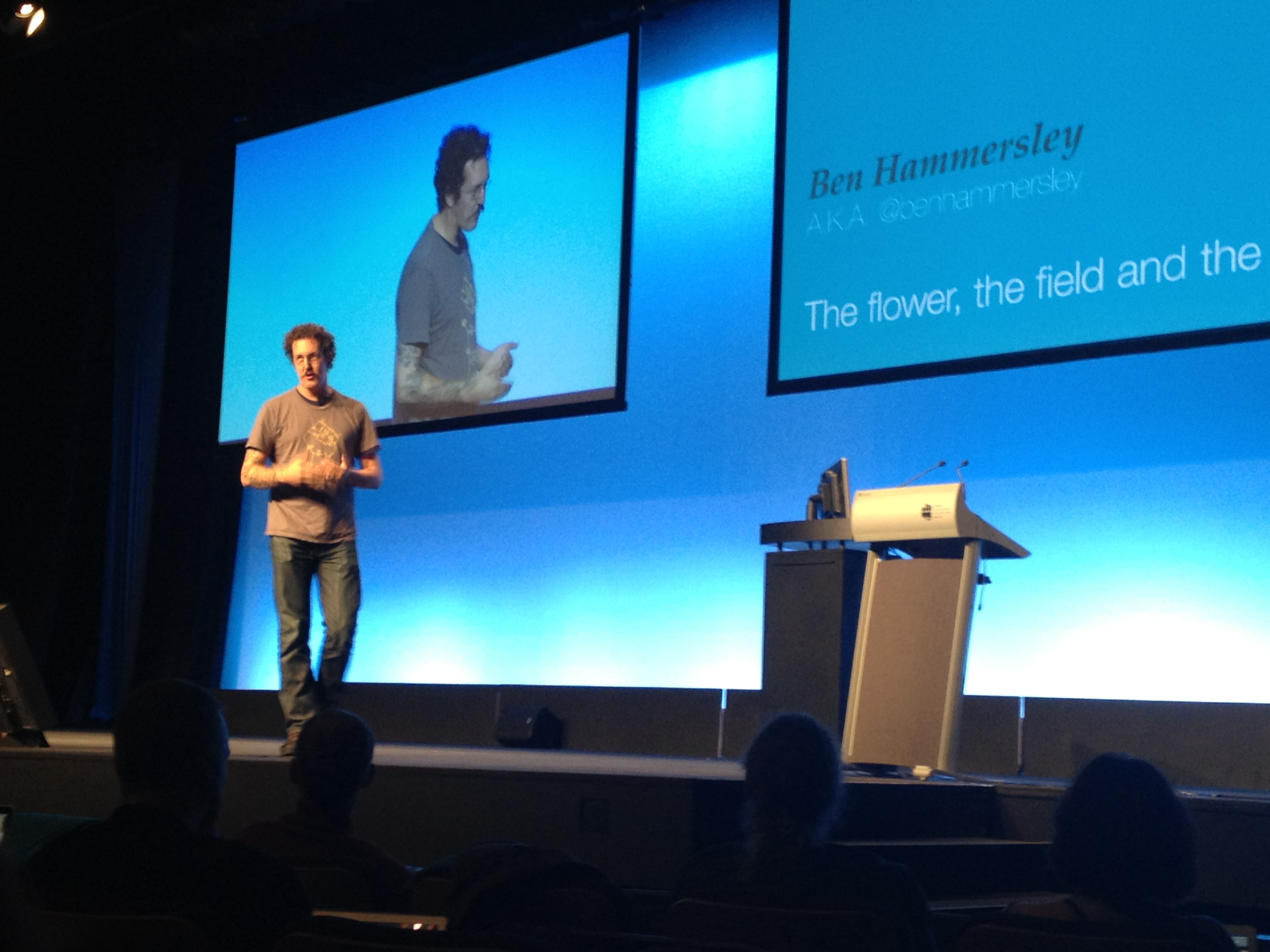
There is nothing like being reminded that you are, in fact, a cyborg. The smartphones and other devices we carry with us everyday are basically extensions of our brains, or so believes Ben Hammersley, UK Wired Editor-At-Large and Ambassador to the UK Government’s Tech City. Closing the first day of this year’s Web Directions South conference, Hammersley explained that the small devices we carry with us everyday, and which we are panicked to be without, are in fact like mental external hard-drives which not only recall information, but point us in the direction of things we didn’t even know, and have the omniscient power to do things like order a taxi with one click or find out when the next bus is coming.

Hammersley’s message punctuated two days of presentations and panels that both took a big picture view of where the world is going with technological innovation, kicked off by Josh Clarke’s Day 1 opening keynote Beyond Mobile, as well as offering more practical insights into the diverse design and development practices shaping today’s web world; from content strategy to responsive design, web security to community management. Most notably this year was the inclusion of a conference track specifically dedicated to startups, an acknowledgment of the rapidly growing tech entrepreneur community in Sydney and around the country.
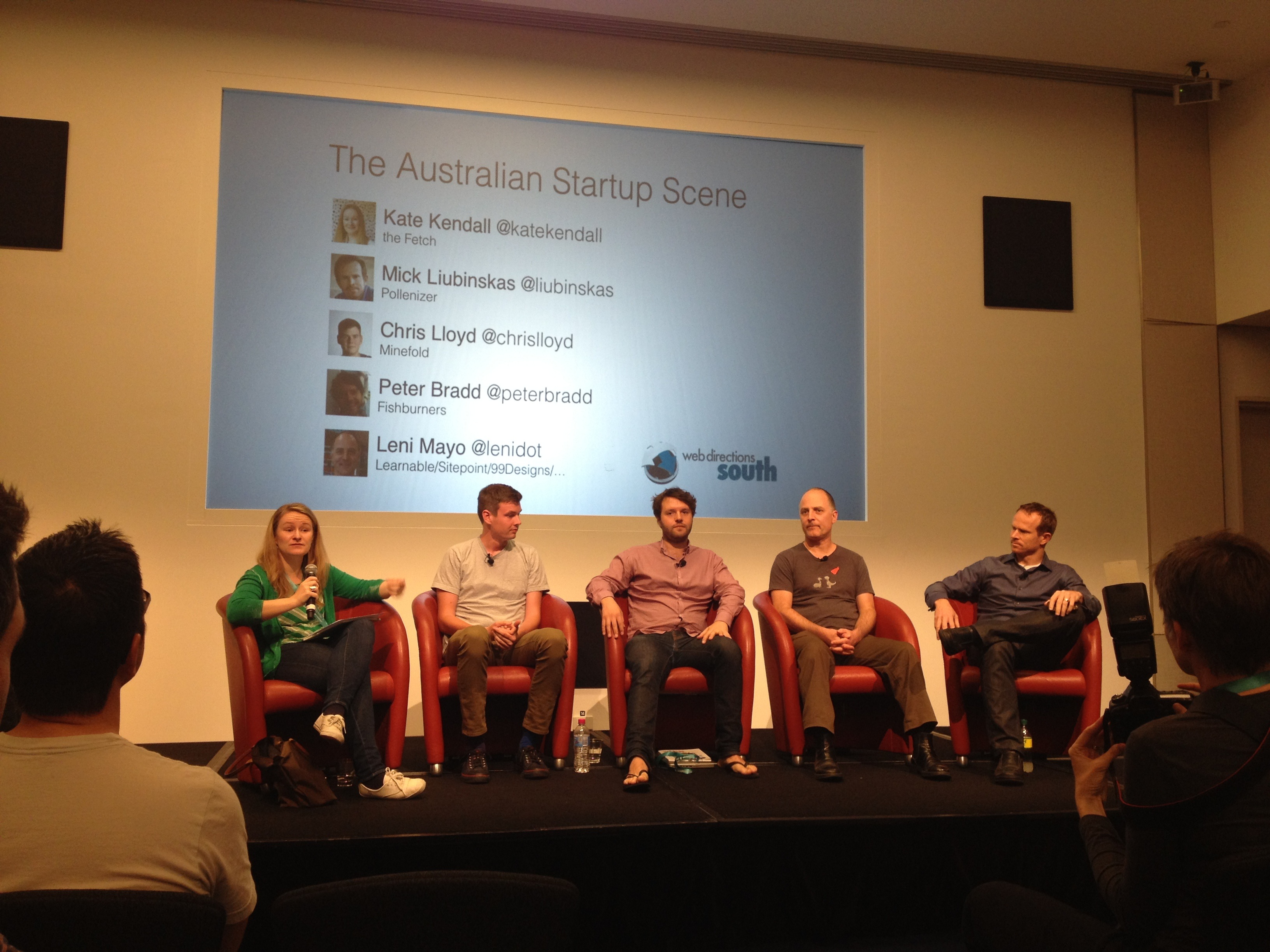
The Startup track covered the spectrum from developing an idea to seeking funding to the experience of participating in a three-month incubator program, with a line-up of seasoned entrepreneurs, from both Australia and overseas, giving an insight into their experience and offering valuable advice to early-stage startups. Highlights include a panel on business models, which explored the various revenue models that are being used to monetise great startup ideas, Derek Powazek’s candid and practical account of his personal startup journey, and the Australian Startup Scene panel, moderated by The Fetch founder Kate Kendall, and featuring some of the country’s leading startup entrepreneurs.

From the energy in the room at the Startup track sessions, it’s clear we are at a very interesting point in the maturity of the Australian startup scene. With some impressive successes behind us, and a growing number of people launching their own tech businesses, the opportunities for awareness, scale and funding are on the rise. However, a sentiment still exists that entrepreneurs need to spend time in an ecosystem like Silicon Valley or San Francisco’s Bay Area to be truly successful. While that may be beneficial for certain startups, it is clear that there is a growing community here dedicated to supporting the success of home-grown startups, which is crucial to the growth of our own entrepreneurial ecosystem. It will be great to see just how much we’ve grown when Web Directions South 2013 rolls around.

About our ambassador // Lauren is Community Director for CollaborativeConsumption.com, and has played an instrumental role in building the global collaborative consumption movement over the last two years.

Design a site like this with WordPress.com
Get started